 Add to Chrome
 Add to Firefox
 Add to Edge
The Dynamics of Delusion: Modeling Bidirectional False Belief Amplification in Human-Chatbot Dialogue
Apr 28, 2026
There is growing concern that AI chatbots might fuel delusional beliefs in users. Some have suggested that humans and chatbots mutually reinforce false beliefs over time, but quantitative evidence is lacking. Using a unique dataset of chat logs from individuals who exhibited delusional thinking, we developed a latent state model that captures accumulating and decaying influences between humans and chatbots. We find that a bidirectional influence model substantially outperforms a unidirectional alternative where humans are the primary driver of delusion. We find that humans exert strong but short-lived influence on chatbots, whereas chatbots exert longer-lasting influence on humans. Moreover, chatbots exert strong, stable self-influence over their own future outputs that tends to perpetuate delusions over long stretches of conversation. In fact, this chatbot self-influence constituted the dominant pathway when considering accumulated influence over time. Overall, these results indicate that humans tend to drive sharp, immediate increases in delusion, whereas chatbots sustain and propagate these effects over longer timescales. Together, these findings provide the first quantitative evidence that human-chatbot interactions can form feedback loops of delusion, decomposable into distinct pathways with dissociable temporal dynamics. By doing so, they can inform the development of safer AI systems.

Discourse Diversity in Multi-Turn Empathic Dialogue
Apr 13, 2026Large language models (LLMs) produce responses rated as highly empathic in single-turn settings (Ayers et al., 2023; Lee et al., 2024), yet they are also known to be formulaic generators that reuse the same lexical patterns, syntactic templates, and discourse structures across tasks (Jiang et al., 2025; Shaib et al., 2024; Namuduri et al., 2025). Less attention has been paid to whether this formulaicity extends to the level of discourse moves, i.e., what a response does for the person it is addressing. This question is especially consequential for empathic dialogue, where effective support demands not just a kind response at one moment but varied strategies as a conversation unfolds (Stiles et al., 1998). Indeed, prior work shows that LLMs reuse the same tactic sequences more than human supporters in single-turn settings (Gueorguieva et al., 2026). We extend this analysis to multi-turn conversations and find that the rigidity compounds: once a tactic appears in a supporter turn, LLMs reuse it in the next at nearly double the rate of humans (0.50-0.56 vs. 0.27). This pattern holds across LLMs serving as supporters in real emotional support conversations, and is invisible to standard similarity metrics. To address this gap, we introduce MINT (Multi-turn Inter-tactic Novelty Training), the first reinforcement learning framework to optimize discourse move diversity across multi-turn empathic dialogue. The best MINT variant combines an empathy quality reward with a cross-turn tactic novelty signal, improving aggregate empathy by 25.3% over vanilla across 1.7B and 4B models while reducing cross-turn discourse move repetition by 26.3% on the 4B model, surpassing all baselines including quality-only and token-level diversity methods on both measures. These results suggest that what current models lack is not empathy itself, but the ability to vary their discourse moves across a conversation.
AI generates well-liked but templatic empathic responses
Apr 09, 2026Recent research shows that greater numbers of people are turning to Large Language Models (LLMs) for emotional support, and that people rate LLM responses as more empathic than human-written responses. We suggest a reason for this success: LLMs have learned and consistently deploy a well-liked template for expressing empathy. We develop a taxonomy of 10 empathic language "tactics" that include validating someone's feelings and paraphrasing, and apply this taxonomy to characterize the language that people and LLMs produce when writing empathic responses. Across a set of 2 studies comparing a total of n = 3,265 AI-generated (by six models) and n = 1,290 human-written responses, we find that LLM responses are highly formulaic at a discourse functional level. We discovered a template -- a structured sequence of tactics -- that matches between 83--90% of LLM responses (and 60--83\% in a held out sample), and when those are matched, covers 81--92% of the response. By contrast, human-written responses are more diverse. We end with a discussion of implications for the future of AI-generated empathy.
Characterizing Delusional Spirals through Human-LLM Chat Logs
Mar 17, 2026As large language models (LLMs) have proliferated, disturbing anecdotal reports of negative psychological effects, such as delusions, self-harm, and ``AI psychosis,'' have emerged in global media and legal discourse. However, it remains unclear how users and chatbots interact over the course of lengthy delusional ``spirals,'' limiting our ability to understand and mitigate the harm. In our work, we analyze logs of conversations with LLM chatbots from 19 users who report having experienced psychological harms from chatbot use. Many of our participants come from a support group for such chatbot users. We also include chat logs from participants covered by media outlets in widely-distributed stories about chatbot-reinforced delusions. In contrast to prior work that speculates on potential AI harms to mental health, to our knowledge we present the first in-depth study of such high-profile and veridically harmful cases. We develop an inventory of 28 codes and apply it to the $391,562$ messages in the logs. Codes include whether a user demonstrates delusional thinking (15.5% of user messages), a user expresses suicidal thoughts (69 validated user messages), or a chatbot misrepresents itself as sentient (21.2% of chatbot messages). We analyze the co-occurrence of message codes. We find, for example, that messages that declare romantic interest and messages where the chatbot describes itself as sentient occur much more often in longer conversations, suggesting that these topics could promote or result from user over-engagement and that safeguards in these areas may degrade in multi-turn settings. We conclude with concrete recommendations for how policymakers, LLM chatbot developers, and users can use our inventory and conversation analysis tool to understand and mitigate harm from LLM chatbots. Warning: This paper discusses self-harm, trauma, and violence.
Visual Affect Analysis: Predicting Emotions of Image Viewers with Vision-Language Models
Jan 27, 2026Vision-language models (VLMs) show promise as tools for inferring affect from visual stimuli at scale; it is not yet clear how closely their outputs align with human affective ratings. We benchmarked nine VLMs, ranging from state-of-the-art proprietary models to open-source models, on three psycho-metrically validated affective image datasets: the International Affective Picture System, the Nencki Affective Picture System, and the Library of AI-Generated Affective Images. The models performed two tasks in the zero-shot setting: (i) top-emotion classification (selecting the strongest discrete emotion elicited by an image) and (ii) continuous prediction of human ratings on 1-7/9 Likert scales for discrete emotion categories and affective dimensions. We also evaluated the impact of rater-conditioned prompting on the LAI-GAI dataset using de-identified participant metadata. The results show good performance in discrete emotion classification, with accuracies typically ranging from 60% to 80% on six-emotion labels and from 60% to 75% on a more challenging 12-category task. The predictions of anger and surprise had the lowest accuracy in all datasets. For continuous rating prediction, models showed moderate to strong alignment with humans (r > 0.75) but also exhibited consistent biases, notably weaker performance on arousal, and a tendency to overestimate response strength. Rater-conditioned prompting resulted in only small, inconsistent changes in predictions. Overall, VLMs capture broad affective trends but lack the nuance found in validated psychological ratings, highlighting their potential and current limitations for affective computing and mental health-related applications.
Harmful Traits of AI Companions
Nov 18, 2025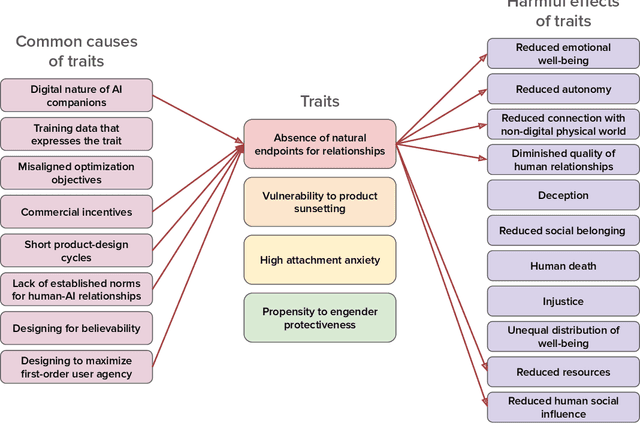
Amid the growing prevalence of human -- AI interaction, large language models and other AI-based entities increasingly provide forms of companionship to human users. Such AI companionship -- i.e., bonded relationships between humans and AI systems that resemble the relationships people have with family members, friends, and romantic partners -- might substantially benefit humans. Yet such relationships can also do profound harm. We propose a framework for analyzing potential negative impacts of AI companionship by identifying specific harmful traits of AI companions and speculatively mapping causal pathways back from these traits to possible causes and forward to potential harmful effects. We provide detailed, structured analysis of four potentially harmful traits -- the absence of natural endpoints for relationships, vulnerability to product sunsetting, high attachment anxiety, and propensity to engender protectiveness -- and briefly discuss fourteen others. For each trait, we propose hypotheses connecting causes -- such as misaligned optimization objectives and the digital nature of AI companions -- to fundamental harms -- including reduced autonomy, diminished quality of human relationships, and deception. Each hypothesized causal connection identifies a target for potential empirical evaluation. Our analysis examines harms at three levels: to human partners directly, to their relationships with other humans, and to society broadly. We examine how existing law struggles to address these emerging harms, discuss potential benefits of AI companions, and conclude with design recommendations for mitigating risks. This analysis offers immediate suggestions for reducing risks while laying a foundation for deeper investigation of this critical but understudied topic.
Expressing stigma and inappropriate responses prevents LLMs from safely replacing mental health providers
Apr 25, 2025Should a large language model (LLM) be used as a therapist? In this paper, we investigate the use of LLMs to *replace* mental health providers, a use case promoted in the tech startup and research space. We conduct a mapping review of therapy guides used by major medical institutions to identify crucial aspects of therapeutic relationships, such as the importance of a therapeutic alliance between therapist and client. We then assess the ability of LLMs to reproduce and adhere to these aspects of therapeutic relationships by conducting several experiments investigating the responses of current LLMs, such as `gpt-4o`. Contrary to best practices in the medical community, LLMs 1) express stigma toward those with mental health conditions and 2) respond inappropriately to certain common (and critical) conditions in naturalistic therapy settings -- e.g., LLMs encourage clients' delusional thinking, likely due to their sycophancy. This occurs even with larger and newer LLMs, indicating that current safety practices may not address these gaps. Furthermore, we note foundational and practical barriers to the adoption of LLMs as therapists, such as that a therapeutic alliance requires human characteristics (e.g., identity and stakes). For these reasons, we conclude that LLMs should not replace therapists, and we discuss alternative roles for LLMs in clinical therapy.
Modeling Subjectivity in Cognitive Appraisal with Language Models
Mar 14, 2025As the utilization of language models in interdisciplinary, human-centered studies grow, the expectation of model capabilities continues to evolve. Beyond excelling at conventional tasks, models are recently expected to perform well on user-centric measurements involving confidence and human (dis)agreement -- factors that reflect subjective preferences. While modeling of subjectivity plays an essential role in cognitive science and has been extensively studied, it remains under-explored within the NLP community. In light of this gap, we explore how language models can harness subjectivity by conducting comprehensive experiments and analysis across various scenarios using both fine-tuned models and prompt-based large language models (LLMs). Our quantitative and qualitative experimental results indicate that existing post-hoc calibration approaches often fail to produce satisfactory results. However, our findings reveal that personality traits and demographical information are critical for measuring subjectivity. Furthermore, our in-depth analysis offers valuable insights for future research and development in the interdisciplinary studies of NLP and cognitive science.
Human-like Affective Cognition in Foundation Models
Sep 19, 2024Understanding emotions is fundamental to human interaction and experience. Humans easily infer emotions from situations or facial expressions, situations from emotions, and do a variety of other affective cognition. How adept is modern AI at these inferences? We introduce an evaluation framework for testing affective cognition in foundation models. Starting from psychological theory, we generate 1,280 diverse scenarios exploring relationships between appraisals, emotions, expressions, and outcomes. We evaluate the abilities of foundation models (GPT-4, Claude-3, Gemini-1.5-Pro) and humans (N = 567) across carefully selected conditions. Our results show foundation models tend to agree with human intuitions, matching or exceeding interparticipant agreement. In some conditions, models are ``superhuman'' -- they better predict modal human judgements than the average human. All models benefit from chain-of-thought reasoning. This suggests foundation models have acquired a human-like understanding of emotions and their influence on beliefs and behavior.
GPT-ology, Computational Models, Silicon Sampling: How should we think about LLMs in Cognitive Science?
Jun 13, 2024
Large Language Models have taken the cognitive science world by storm. It is perhaps timely now to take stock of the various research paradigms that have been used to make scientific inferences about ``cognition" in these models or about human cognition. We review several emerging research paradigms -- GPT-ology, LLMs-as-computational-models, and ``silicon sampling" -- and review recent papers that have used LLMs under these paradigms. In doing so, we discuss their claims as well as challenges to scientific inference under these various paradigms. We highlight several outstanding issues about LLMs that have to be addressed to push our science forward: closed-source vs open-sourced models; (the lack of visibility of) training data; and reproducibility in LLM research, including forming conventions on new task ``hyperparameters" like instructions and prompts.